
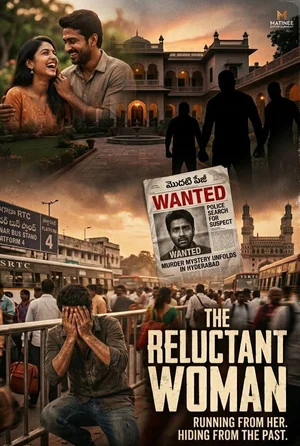
Vijay: The reluctant woman
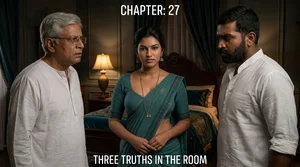
Chapter 27
Three Truths in One Room
The ceiling fan turned. Somewhere upstairs, Kavya laughed at something Arjun had said — a clean, unguarded sound, the sound of a child who feels safe inside the house she lives in.
It was that sound, in the end, that broke it.
Not the weight of the room. Not Babai's question still hanging in the air. Not the thirty years of careful silence that had been building toward this moment. Just a girl laughing upstairs, with no idea what she was doing to the three people standing below her in the dim light of her father's study.
Ramana closed his eyes.
Opened them.
And said, very quietly:
"Vijay."
Not Priyanka. Not the careful neutral courtesy he had maintained for four weeks of careful performance.
Vijay.
The name surfaced in the room like something that had been held underwater for a very long time and had finally, simply, run out of the strength to stay down. Babai went completely still. Vijay did not move — but something behind Priyanka's composed face shifted, the way a locked door shifts when the right key finally turns, the tumblers falling into alignment one by one.
* * *
He came around the desk. Not the powerful landlord. Not the careful operator who had been managing this situation from a distance for years. Just a man in his forties, still in the cream kurta he had worn to the temple that morning, who was exhausted from carrying something too heavy for too long and had finally, in this room, reached the end of his ability to carry it.
"I knew from the first night," he said. "Babai called me the moment you rang his doorbell. Every step that followed — the disguise, the troupe, the villages, this house — I arranged it. All of it."
He stopped. Then, quieter:
"I watched Ravi's reports every single day. Where you slept. What you ate. How you were managing." He paused for a long moment, and when he continued his voice had dropped further. "The checkpoint on the highway — when Ravi reported what that officer did, the way he looked at you, the way you had to sit there and endure it without breaking—" He turned toward the window. The repaired plaster near the frame was visible if you knew to look for it. "I put my fist through that wall."
He turned back. His eyes were on Vijay's face, and they held something that had not been permitted there in all the weeks of careful performance — something direct and unmanaged and old.
"I told myself the mission mattered more than the cost. I told myself you were strong enough." His voice went quieter still. "I was right about both of those things. And I have not slept properly since the night you first walked through my gate."
* * *
"I know you knew."
He let the words sit plainly. No performance around them, no feminine softness shaping the delivery. Just Vijay's voice — the voice that had been living underneath Priyanka's careful construction for weeks, speaking now from its own register.
"Ravi gave me a device the night of the first meeting. In the car, before I came inside. He had it on himself and he slipped it onto the seat where I would find it, with a note that said — " a pause, the briefest tightening around his eyes — "that guilt was killing him and I deserved to know the truth."
Ramana's face changed. The specific expression of a careful man realising that the person he had believed he was managing had been several steps ahead of him for considerably longer than he had imagined.
"I heard everything that happened in this house that night," Vijay continued. "You, Ravi, Babai. All of it."
The silence that followed had a different quality to the ones before it. More complete.
"I heard about Srinivas Rao," he said. "The trap you designed. The politician. The timing." His hands were still in his lap, the silver bangles resting quiet on his wrists. "I walked into that warehouse not knowing I was supposed to walk into it."
"You were not supposed to be there at all."
Ramana said it without management, without the layered control he brought to everything. Just the raw, unguarded fact of it.
"The collection was scheduled an hour before your shift ended. You should have been gone. Something delayed you and I did not know until it was already too late." The muscle along his jaw moved once. "I have replayed that hour every day since."
The room absorbed it.
Vijay looked at his brother across the dim study — the fifteen years of distance, the gate in Banjara Hills, the small bag, the walking away — and asked the question that had been sitting in his chest since he was twelve years old and had no one left.
"Why did you not come back for me?"
* * *
Babai found the chair near the window. He lowered himself into it with the deliberate care of a man whose body has decided that the weight of the conversation has earned his surrender. He took his glasses off and held them in both hands, turning them slowly.
"Because I told him not to," he said.
Both brothers looked at him.
The old man did not look at either of them. He looked at the floor between them, at fifteen years of a decision he had been living inside.
"Your father's debts," he began. His voice was steady in the way of someone who has rehearsed a thing many times in private and is now, at last, saying it aloud. "When they reached the point of no return, I understood exactly what Srinivas Rao would do. I had seen it before. A man dies. His debts become his family's. His sons become the don's property — to work, to serve, to be used in whatever way the don finds convenient."
He looked at Ramana.
"You were twenty-four. Newly married. Lakshmi had done nothing wrong in her life — she had simply had the misfortune of marrying into the wrong family. If Srinivas Rao connected you to your father's debt, he would have owned both of you for the rest of your lives. So I went to you quietly, before the worst had happened, and I said: take Lakshmi, leave the city, change your name, disappear completely. Tell no one." He paused. "Not even Vijay."
The fan turned overhead. Somewhere in the house, a door closed softly — one of the children moving between rooms, unaware.
"And you thought I would be safe," Vijay said. Not an accusation. A statement of the reasoning, laid out clearly so it could be examined.
"You were twelve," Babai said. "A child. Srinivas Rao had no use for a twelve-year-old boy — no income, no assets, no leverage. We calculated that he would ignore you. That you would be taken in by a neighbour, perhaps a distant relative. That your youth and your poverty would protect you, because there was nothing to take." He stopped. When he continued, something in his voice had shifted — not broken, but cracked, the way old stone cracks under sustained pressure. "What neither Ramana nor I anticipated was that Srinivas Rao would look at a hungry, homeless boy on the street and see something useful after all."
The room held that.
"I left you to be ignored," Babai said. "Instead you were collected. That is my mistake. I have carried it for fifteen years, and I will carry it for whatever years are left to me."
Vijay sat with it. The candlelit makeup room. The careful hands. The door opened without hesitation at midnight, the only door in the world that had opened for him in a very long time. Not just sentiment. Not just a maternal uncle's love. A debt, being paid the only way this man had known how to pay it.
He said nothing. But something in him settled — not forgiveness, not yet, but the beginning of the shape that forgiveness takes before it fully forms.
* * *
"Now," Vijay said. "Suresh."
The temperature in the room changed.
"He told me his version," Vijay continued. "His wife. His sister. His career destroyed overnight. He holds you responsible. He has spent five years building everything around making you feel what he felt."
Ramana stood very straight. When he spoke, his voice was the quietest it had been all evening — not the controlled quiet of a man managing his delivery, but the quiet of someone standing very close to something he rarely allows himself to approach.
"Suresh killed my wife."
Babai closed his eyes.
"We were living in Vizag," Ramana said. "A simple life. A rented house near the market, two small children, Lakshmi growing tomatoes on the balcony. I was doing accounts work for a local firm. No one knew who we were or where we had come from. We had been careful. For years we were careful, and it had worked."
His jaw tightened imperceptibly.
"Suresh was conducting an encounter operation against Jagannatha Rao's men in our neighbourhood. There was a chase. Gunfire. Lakshmi had gone out to buy vegetables — tomatoes, I think, for a recipe she had been trying all week. She was in the wrong street at the wrong moment."
He stopped. Continued.
"Suresh's bullet killed her. Instantly. She was thirty-one years old. My children were six and three."
The room had no response to that. There is no response that is adequate.
"I went to the police," Ramana said. "I went to the human rights commission. I went to every office whose name I could find. I wrote letters. I made appointments. I stood in corridors and waited." His expression did not change, but something behind his eyes was very old and very tired. "Suresh filed his report before I had found my way to the first office. In his version, Lakshmi was a ganja supplier attempting to flee arrest. She had attacked a police officer. The shooting was lawful self-defence."
A pause.
"Within a week there were documents. Records. Witnesses who had seen nothing but had signed statements regardless. She became, on paper, a criminal. And I became the husband of a criminal — a man with two small children and a grief he was not permitted to name, because the woman he was grieving had, according to the official record, brought it upon herself."
He looked at Vijay directly.
"I tried for two years. Legally. Properly. Every channel that existed. At the end of those two years I understood that the only power capable of holding a man like Suresh to account was the kind I did not possess. So I went and got it."
* * *
Vijay sat with it all for a long moment. The teal saree was still. The thali rested at his throat. Outside, the Godavari night carried its usual sounds — the river, the insects, the distant call of a night bird.
"Suresh lost his wife too," he said, finally. "Not in the same way. But the machinery was the same — a powerful man, a false record, a system that protected the person who had caused the harm. He lost everything he had built. He was made into a monster in the public record." He paused. "He did to you exactly what was done to him. And neither of you can see it, because you are each standing too close to your own version of the story."
Ramana looked at him sharply.
"I am not defending him," Vijay said. "He planned this from the beginning. He used me — used all of us — as pieces in a design that has nothing to do with justice and everything to do with making you watch your world come apart the way yours came apart for him." He held his brother's gaze. "But I am telling you what I see from where I am standing. Two men. The same wound. The same choice. The same blindness about what the choice has made them."
Babai, quietly, from his chair by the window:
"The boy is right."
Ramana said nothing. He looked away — the first time all evening he had looked away from anything — and the study held the silence respectfully.
* * *
Vijay let the silence run its length. Then:
"One more thing. Suresh's wife. His sister. What happened to them after your men went to his house — I need to understand what you actually ordered."
Ramana turned back. The expression on his face was not evasion and not defensiveness. It was the face of a man preparing to say something he has said to himself many times in private and has never once found a way to make it sit comfortably.
"I ordered them frightened," he said. "Watched. Followed. I wanted Suresh to feel exposed — to understand that the protection he believed his uniform gave him did not extend to the people he loved. I wanted him to feel, in some small degree, the vulnerability he had handed to every family that had filed a complaint and been ignored." He met Vijay's eyes and did not look away from them. "I did not order what they did."
A pause that had considerable weight in it.
"Two of those men are dead. The third is alive in the technical sense of the word." His voice was level, but the levelness itself said everything. "It does not undo it. My order created the conditions. I know that. I have known it from the moment I found out, three days after the fact, and nothing I have done since has changed it or absolved it."
Vijay looked at his brother for a long time.
Then he said, not unkindly:
"Suresh became what he became because a man with power made a decision that harmed innocent people, and told himself it was justified, and then discovered he was wrong only after the damage was permanent." He let that settle between them. "You are a careful man. I believe you. I believe the order you gave was not the order they carried out." Another pause. "But I think you already know that the distinction, while real, does not release you from the weight of it."
Ramana said nothing. There was nothing to say. Some truths are not answered — they are only received.
* * *
"Suresh is going to move soon," Vijay said. He had shifted register again — the strategic, precise quality that had been developing in him for weeks, the part of his mind that Srinivas Rao's world had sharpened and the drama troupe had refined into something considerably more dangerous. "Whatever his final design is, it centres on this house. These children. He wants you to watch everything you love be destroyed in the same methodical way you watched Lakshmi be destroyed — helpless, unable to stop it, the official version saying it was your own fault."
He looked at both of them in turn.
"The network survives if this ends as a personal matter between the two of you. Someone fills the space Jagannatha Rao has been building. Nothing changes for the villages these men operate in, for the families they collect money from, for the next Srinivas Rao who finds the next twelve-year-old boy sleeping on the street and decides he is useful." He paused. "That is not a result I am willing to accept."
He looked at Babai.
"You built something that was meant to be temporary. You have watched it become something else entirely and you know it. The children upstairs called me Amma tonight, and you sat at that table and heard it, and you know as well as I do that there is no clean extraction from this that leaves everyone intact."
He looked at Ramana last, and held his gaze for a long moment before he spoke.
"I am not Suresh's instrument. I am not your operation. I am not a piece that anyone placed on a board and gets to move." His hand passed once, briefly, across the front of the teal saree — encompassing the thali, the bangles, the feminine construction that had been someone else's design and had become, over weeks and against every intention, something he had made genuinely his own. "I am the person who is going to finish this. Not for either of you. For those two children who have already lost one parent to this world's indifference and are not going to lose another because two men could not see past their own grief long enough to aim at the thing that actually deserves to be destroyed."
The room was completely still.
* * *
Babai put his glasses back on. He looked at the boy he had dressed as a woman in a candlelit room with careful, guilty hands — now sitting across from the brother he had told to leave, in the house of the man whose wife had been killed, wearing the thali that made the whole impossible configuration legal — and he said, simply:
"What do you need from us?"
Ramana looked at his younger brother across the desk. Not the operator assessing an asset. Not the careful landlord managing a variable. The expression on his face was something older than any of the roles he had been performing, something that had been present that morning at the gate in Banjara Hills when a twenty-four-year-old man had looked at a twelve-year-old boy with sad eyes and had not found a way to stay.
He pulled out his chair and sat down.
"Tell me everything you know about Suresh's timeline. His contacts, his resources, what he has that we need, what he wants that we can use." He set his hands flat on the desk, open, the gesture of a man who is done managing the distance between himself and the people in the room. "And then I will tell you everything I have been building. Every piece of evidence, every name, every connection. The whole structure."
He held Vijay's gaze.
"All of it. Together. The way we should have done this from the beginning."
Vijay looked at his brother for a long moment.
Then he leaned forward, and the thali caught the lamplight between them, and the three of them began.
Upstairs, the house was quiet. The children were asleep. The dining table — the one that had gathered dust for three years before a woman in a cotton saree had declared, without asking anyone's permission, that it would be used — still held the faint scent of jasmine from the evening's flowers.
The river moved in the darkness outside, carrying nothing and everything, the way rivers do.
For the first time since a gate in Banjara Hills, two brothers were in the same room, on the same side, working toward the same thing.
To be continued...
Discussion (6)
Please continue the story and add thriller and romance stories too.
कृपया कहानी को आगे और लिखिए। थोड़ा रोमांस भी इसमें होना चाहिए
Wow..what a story..really mindblowing ..you nailed it Lavs.
I want this story to have some romance, kissing and sex.
I just started reading it... will give a detailed feedback once done. So far my opinion is awesome.
You might find few parts of this story taboo'ish... I suggest keep reading 🙂