
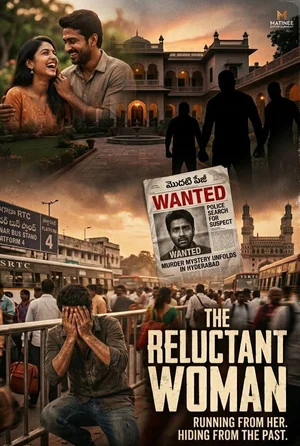
Vijay : The reluctant woman
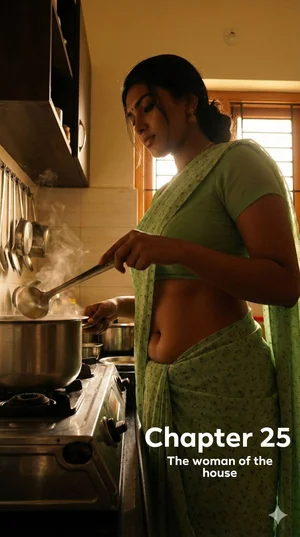
Chapter 25: The woman of the house
Arjun came to Vijay differently.
Not seeking, not offering — testing. With the specific methodical patience of a boy who had appointed himself the household's quality control and took the responsibility seriously.
The second morning. Priyanka was in the kitchen at six in a simple green cotton saree — practical, everyday, tied low on her wide hips with the full bare midriff exposed in the morning air, the fitted green blouse holding her heavy breasts close, the gold chain and thali resting in the valley of her cleavage. Her hair was pulled back as low messy hairbun, no jasmine, a few strands loose around her face. She looked like a woman who had been up for an hour already and had other things on her mind than her appearance.
Arjun appeared in the kitchen doorway in his school uniform, bag over one shoulder.
"You don't have to do that," he said. Observational. "We have staff."
"I know," Priyanka said, without turning from the stove. "I'm not doing it for them."
"Then why?"
She turned. In the morning kitchen light the green saree caught the overhead bulb warmly — the smooth bare midriff, the full figure, the dark braid over one shoulder, the kajal still precisely in place from this morning's careful application. Her image was not sensual. Its intentionally maternal. She handed him the glass of tea.
"Because I wanted to know how you take it," she said. "Strong. Not too sweet. Right?"
He looked at her. Something shifted behind his eyes — the first small crack in a careful reserve. He drank the tea.
"Kavya takes it with too much sugar," he said eventually.
"I noticed," Priyanka said. "I'm going to reduce it gradually so she doesn't catch on."
The corner of his mouth moved. He picked up his bag and left.
He picked up his bag and left for school. He didn't say thank you. But he also didn't leave immediately after the tea was finished, and Vijay had learned to read what Arjun's lingering meant. The boy stayed when something was worth staying for. The tea had been worth staying for.
One more inch, Vijay thought. One more inch every day.
---
Arjun kept his distance but his innocent testing continued in different forms over the following week. Arjun operated on a specific logic — he would present Priyanka with a situation that required something from her, and then he would watch what she did, and he would file the result.
He mentioned once, very casually at breakfast, that his history project was due on Friday and he wasn't sure about one section. He didn't ask for help. He simply mentioned it.
Priyanka said: "Show me tonight after dinner."
He showed her. She sat with him at the dining table for an hour, going through the section not by correcting it but by asking questions — what did you mean here, why did you choose this example, what's the connection between these two events — until Arjun had argued his way to his own improved version and was looking at the result with the specific satisfaction of someone who has done something properly.
"You didn't just give me the answers," he said, not quite accusingly.
"You didn't need the answers," Priyanka said. "You needed to think it through."
He looked at her for a moment with that particular look she was learning to recognise — the look he gave when he was revising his assessment and wanted to do it privately without her watching. She turned back to her own reading and gave him the privacy.
Two days later he came to her first, without being prompted, with a question about a maths problem he had been working on. He sat down at the table beside her as though it were already an established habit.
Vijay felt something settle in the room around them. Something that had been uncertain choosing, quietly, to become certain.
He answered the maths question. He kept his face entirely neutral. Inside, something that was not strategy and not mission calculation noted the moment with a care he had not budgeted for.
---
The dining rule changed the household.
Vijay had observed by the third morning that meals were scattered and solitary — Ramana at his desk, Kavya in her room with a book, Arjun eating quickly to get back to something else. The dining table, large enough for ten, had the particular dusty dignity of furniture that is maintained but not used.
At breakfast on the third day, while placing plates, Priyanka said it simply and without preamble: "From today — if everyone is in the house — breakfast, lunch, dinner, we eat together at this table."
Priyanka announced it while setting plates — still in the green everyday saree, hair in a plain braid, the bare midriff and the thali and the bangles all present and accounted for, entirely unhurried.
Kavya looked up from her book immediately, something brightening in her expression.
Arjun glanced at Priyanka, then at his father.
Ramana had been standing near the window with his morning tea and his phone. He looked across the room at Priyanka with an expression she catalogued quickly — surprise, a brief calculation, and beneath both of those something more private that he contained before she could fully read it. He opened his mouth.
"Reasonable," Priyanka said, meeting his eyes steadily, before he could say whatever he had been about to say.
A beat of silence. Kavya said "yes" with a finality that ended the discussion. Arjun sat down. Ramana put his phone in his pocket and came to the table.
That first meal together lasted forty minutes. It was slightly awkward in the way of people relearning how to occupy the same space for a shared purpose — Kavya talking to fill the silences, Arjun calibrating his words, Ramana asking questions that were a few degrees too formal. Priyanka moved between them all, asking the questions that kept conversation from stalling, redirecting when something became too stiff, letting the silences that were comfortable stay comfortable and dissolving the ones that weren't.
By the end of it, something small but real had shifted in the room.
Vijay felt it and noted it without attaching too much to it. He was doing what needed to be done. The fact that it was working was operationally useful.
He told himself that and mostly believed it.
---
Within two weeks the dining table had become the fixed point of the household's day.
Kavya had claimed the seat directly beside Priyanka as her permanent position and defended it with the territorial instinct of a cat who has identified the warmest spot in the room. Arjun had stopped the rapid efficient eating that said I have somewhere more important to be and had begun arriving at meals with the slightly more relaxed posture of someone who had decided the table was worth his time. Ramana arrived on time — not the five-minutes-late of a powerful man making others wait, but actually on time, phone in pocket, present.
The conversations that happened at that table over those weeks were, in their accumulation, more informative than anything Vijay could have extracted through deliberate intelligence work. Not because anyone said anything dangerous — they didn't, not yet — but because the texture of a family's daily life, observed from the inside, told things that no document or overheard phone call could tell. Who deferred to whom. What topics caused which silences. What Ramana's face did when his children talked about their mother, which was rarely but with a specific weight when it happened. What the household was afraid of and what it hoped for and how those two things were managed in the daily negotiation of living together.
Vijay observed all of it with two simultaneous awarenesses that he had learned to hold together without letting them collapse into each other — the cold professional attention of a man gathering intelligence, and something else, something less categorisable, that was simply the experience of being present in a family that was slowly, carefully, finding its way back to itself.
---
Priyanka also found a different way to manage Ramana.
It started on the fifth day, Priyanka came to the study door at one in the afternoon and knocked. She was in a deep maroon saree that day — the colour of concentrated attention — the blouse fitted and the midriff bare above the low waist, the gold chain and thali catching the hall light, the dark hair in a low bun with a few escaped strands. The full figure in the doorway of the study had a particular quality of composed authority.
Ramana opened it looking distracted — the particular distraction of a man in the middle of something — and said, with careful neutral courtesy, "Yes?"
"You haven't eaten," Priyanka said. Not a question.
He looked at her for a moment. "I'm in the middle of—"
"I know what you're in the middle of," she said.
"The food is on the table. It'll take fifteen minutes. Come and eat and then go back to the middle of it."
A beat of silence. Something moved across Ramana's face — not quite amusement, not quite surprise, something in the register between them. He looked at her for a moment longer than the situation technically required.
Then he came out of the study.
It became a pattern without either of them formally establishing it as one. Ramana worked long and often forgot meals. Priyanka noticed and addressed it with the specific, matter-of-fact directness of someone who has decided that the wellbeing of the household is their domain and is not asking permission to operate within it.
"You look tired," she said one morning at breakfast, setting his coffee down. "What time did you sleep?"
"Late," he said, without looking up from what he was reading.
"How late?"
A pause. "Two."
"That's not late," Priyanka said. "That's the middle of the night." She sat down across from him. "Is it the same issue as last week or something different?"
He looked up then. The specific quality of the look — not defensive, not pleased, something between the two — told Vijay that Ramana was encountering something he hadn't budgeted for. Not a woman performing wifely care. A person who was paying actual attention and acting on what they observed.
"Something different," he said carefully.
"Is it something I need to know about?"
Priyanka asked. Direct. Neither aggressive nor deferential.
Another pause, longer. "Not yet."
"Alright," she said. "Eat something. You think better when you've eaten."
He ate. He didn't say thank you but he also didn't return to his reading while she was at the table, which was, she had learned, Ramana's version of the same thing.
The pattern deepened. Priyanka began tracking the household's operational needs — what the children required for school, what supplies the kitchen needed, what maintenance the building needed — and presenting Ramana with consolidated information at dinner rather than letting things accumulate into problems. Not asking permission. Informing. The generator needs servicing. Kavya needs new textbooks for next term. The kitchen staff need clarity on the weekly grocery budget.
Ramana received each item with a brief nod or a question and handled it. What he didn't do was tell her to route any of it back through the staff or through him separately. He accepted, without announcing the acceptance, that this was how the household was going to be run now. That there was someone in the house who was paying attention to the whole picture and bringing it to the table.
Vijay watched him accept this and thought: You expected a cover story. You got someone who actually runs a household. You don't know how to account for that.
One evening she looked across the sitting room at Ramana with his tea and said: "You should go to the doctor this week. Your shoulders have been bothering you for ten days."
Ramana looked at her. "How do you know about my shoulders?"
"Because you've been rolling your right shoulder the same way every morning for ten days," she said. "And you took paracetamol from the kitchen cabinet twice. And you've been sitting differently at dinner." She held his gaze. The deep blue saree she wore that evening caught the sitting room lamp, the silver thread alive in the light, the bare midriff sheened with the warmth of the evening. "Go to the doctor."
Arjun, without looking up from his schoolwork: "She's right, Nanna. You've been doing the shoulder thing."
Ramana looked from his son to his wife. Something in his expression — very briefly — was the beginning of something warmer than the careful composed regard he had been maintaining.
"I'll go Thursday," he said.
"Wednesday," Priyanka said.
"Wednesday," he agreed.
---
Ramana watched all of it.
He sat with his observations in the privacy of his study and turned them over with the careful attention he brought to anything that didn't behave as expected.
He had arranged this. He had placed the pieces — Babai, the disguise, the drama troupe, Ravi's reporting, the marriage — with the specific intention of getting Vijay inside the mansion while positioning himself to move against Suresh. He had known who Priyanka was from the beginning. He had prepared himself for his younger brother maintaining a cover, gathering information, surviving.
He had not prepared himself for what he was actually watching.
He watched Priyanka in the kitchen at six in the morning in a plain everyday saree, hair in a working braid, moving through the household with a settled natural authority that came from having decided to inhabit a space completely. He watched her at the dining table — in whichever saree the day called for, the thali always at her collarbone, the bangles always chiming — managing four different people's needs simultaneously and making it look like simply being present.
He watched her come to his study door in the maroon saree with that composed expression and tell him, without ceremony or apology, that he hadn't eaten and the food was on the table. He had stood in the doorway after she walked away and tried to locate what he was feeling. It wasn't gratitude exactly. Something older and more specific. The feeling of being looked after by someone who was doing it because it was simply the right thing to do.
He knew that quality. He knew it from a voice that had been silent for a long time.
One evening at dinner — Priyanka in a soft coral saree, the blouse fitted and the midriff bare, the gold jhumkas swaying when she turned her head, the thali resting in the warm cleavage of the blouse — she was passing the rice to Kavya while redirecting a conversation that had been drifting toward something that would upset Arjun, and she made a small joke that landed perfectly, and both children laughed, and in the light of that moment Ramana looked at the face across the table and felt the ground shift slightly under his thinking.
The profile. The angle of the head when listening. The specific way of giving attention that made the person receiving it feel like the most important thing in the room. The quality of patience — not performed but real, the kind that comes from someone who has decided the people in front of them are worth whatever it costs.
He had last seen that quality in a face thirty years ago.
In a house in Banjara Hills with cool marble floors and filter coffee and jasmine every morning. At a dining table where a woman had managed the space between a twenty-four-year-old boy and a twelve-year-old boy and a man who was losing everything to gambling, and had done it with exactly this quality of unhurried, undefeated presence.
*He's using Amma as his model.*
The realisation moved through Ramana slowly — not as a sudden shock but as something arriving in stages, each stage more complete. Vijay had been twelve when their mother died. He had had twelve years with her. And he had apparently absorbed something in those twelve years.
Ramana found, sitting alone in his study, almost unbearable to witness.
*He remembered her better than I thought,* Ramana realised. *Or he needed her so badly after I left that he held onto everything.*
The second thought landed harder than the first.
He had left. He had picked up one small bag at a gate in Banjara Hills and walked away from a twelve-year-old boy who had nobody and nothing, and he had told himself it was survival, and he had been right, and the rightness of it had never fully absolved it.
Vijay had been alone with that grief. And in the aloneness he had held onto their mother — held onto her so completely that when he was given a role requiring her quality, he found it ready.
Ramana looked at Priyanka across the dinner table — his brother, in a coral saree, laughing with his children, the gold jhumkas catching the light, the thali resting in the warm cleavage, the bare midriff above the saree's low waist — and felt the full, unmanageable complexity of what he had built crash over him quietly and completely.
He had done this. He had put Vijay in that body and in this house and in this role. He had told himself it was the only way. He had told himself Vijay was capable enough, practical enough, tough enough.
He had not told himself what it would feel like to watch his younger brother become, with patient and genuine care, the mother his children had been missing for three years. He had not told himself that he would have to sit across a dinner table every evening and watch it and say nothing and feel nothing and perform the role of a man who had married a stranger.
He looked away from Priyanka and found Arjun watching him from across the table with the precise, private attention that was so entirely his father's.
Ramana met his son's eyes. Said nothing.
Arjun said nothing either. But the expression on the boy's face told Ramana that his son had made his evaluation of the woman at this table and approved the result.
*None of them know,* Ramana thought. *None of them have any idea.* And underneath that, quieter: *I hope to God they never have to.*
---
The bedroom remained its own careful negotiation.
The first night: Ramana on one side of the large bed, Priyanka on the other, a stretch of empty linen between them. He had said goodnight in a voice entirely normal and entirely careful. She had said goodnight in return and turned toward the window.
Vijay lay in the darkness in a simple cotton nightdress — thin white fabric, short sleeves, the heavy breasts visible against the light material, the bare legs below the hem — and listened to the house settle. The ceiling fan. The courtyard below. The distant river. The breathing of the man three feet away who was his brother and the most complicated person he had ever had to understand simultaneously.
*This is the strangest thing I have ever done,* he acknowledged.
Then: *Go to sleep. Tomorrow is work.*
He slept.
The nights established their own unspoken pattern. Ramana read before sleeping — reports, documents, never anything left visible for Priyanka to see. Priyanka kept a small book on her bedside table and thought through the day's observations until her mind slowed enough to rest. The distance between them remained — slightly less geometric after the first week, the way space between two people in a shared bed normalises without either person consciously adjusting, but still present. Still clear.
Neither of them reached across it. Neither of them commented on the fact that they didn't.
It was, Vijay thought sometimes in those quiet pre-sleep minutes, one of the more honest arrangements in the house.
---
The word came from Kavya first.
Three weeks after the marriage, on an ordinary evening. The dining table, the geography project, the coloured pens. Kavya talking without pause about her teacher and a girl in her class and the injustice of an assignment. Priyanka in a soft mustard yellow saree that evening — the blouse fitted and short, the bare midriff warm in the table lamp's light, the deep navel visible above the saree's low waist, the thali and the gold chain at her collarbone, the dark braid over one shoulder — listening and responding and drawing arrows on the map when directed.
At some point Kavya said, without noticing she was saying it: "*Amma*, do you think the Krishna delta is larger or—"
She stopped.
The silence that settled over the table was brief and very specific.
Kavya looked up. Her expression was half alarmed and half something else — hopeful and frightened at the same time, the face of a child who has said a true thing by accident and is waiting to find out whether the truth will be welcomed.
Vijay looked at her across the table in the mustard yellow saree — the thali at his collarbone, the bangles on his wrists, the braid over his shoulder — and felt something move through his chest that had nothing to do with strategy.
"The Krishna delta," he said, keeping his voice entirely steady, "is significantly larger. Pass me the blue pen."
Kavya passed the blue pen. Her hand was slightly unsteady.
They continued the project. From that evening Kavya used the word without hesitation, without the flash of alarm, with the ease of something that had been true for a while and had simply been allowed to be said.
Vijay carried it quietly in the part of himself where he kept the things that were simply real.
---
Arjun's moment came differently.
Late on a school night, past ten. The house quiet. Priyanka in the kitchen in a simple cotton saree — dark green, practical, the bare midriff cool in the night air, the braid loose from the day's activities, a few jasmine flowers still in the dark hair. She was finishing the last things of the evening when she heard something from the upper corridor.
She went upstairs.
Arjun was sitting on the floor outside his room with his back against the wall and his knees drawn up, and he had the specific quality of stillness that wasn't calm but its opposite — the stillness of someone who has been holding something tightly for a long time and is approaching the limit of how long they can continue holding it.
Priyanka sat down on the floor beside him without asking. The dark green saree pooled around her, and the gold chain visible in the dim corridor light, the thali resting still at her chest. She said nothing. She had learned that with Arjun the most important thing was simply to arrive and stay.
They sat in silence. Two minutes.
"Today was her birthday," Arjun said. To the wall.
Lakshmi, Vijay understood immediately. His mother.
He didn't say anything. He let the silence hold it.
"Kavya forgot," Arjun continued. Still to the wall. "She didn't forget — she was little when it happened, she doesn't really know the date. Nanna remembered. I could see it in his face at dinner but he didn't say anything either. We all just sat there and none of us—" He stopped.
Priyanka reached over and placed his hand over Arjun's. Not speaking. Not offering consolation. Simply being there with the specific weight of a person who is not going anywhere.
Arjun looked down at the hand over his for a moment. Then he leaned sideways, very slightly, until his shoulder was against Priyanka's shoulder. He didn't say anything more. He didn't ask for anything. He simply leaned into the contact the way someone leans into warmth when they have been cold for a long time and finally, unexpectedly, find it available.
They sat like that for a while in the quiet corridor.
Then Arjun straightened up and said, in a voice that was almost entirely normal: "You should sleep. It's late."
"So should you," Priyanka said.
"I will." He stood up. He looked down at Priyanka sitting on the corridor floor for a moment with an expression that had nothing of the testing quality left in it. Something had been decided and the deciding was finished.
"Thank you," he said simply.
Then he went into his room and closed the door quietly.
Vijay sat on the corridor floor alone for a moment in the dim light.
Be careful, he thought. And then, immediately: Too late. Too late for that now.
He got up, went back downstairs, finished the kitchen, and went to bed.
---
The next morning at breakfast Arjun sat down, poured his tea, and said without preamble: "Kavya's birthday is next month. She wants a surprise but she's been dropping hints so obvious that I think she wants to make sure someone actually notices."
He said it to the table generally. But he was looking at Priyanka.
"How obvious are the hints?" Priyanka asked.
"She mentioned the specific bakery she likes every day for a week," Arjun said. "And she brought up her age three separate times in conversations that didn't require it."
Priyanka looked at Ramana across the table.
Ramana was looking at his son with an expression that had shed several of its usual layers — something open and quietly undone in it, the face of a father who has just watched something happen that he didn't know to hope for.
"We have a month," Priyanka said to the table. "We can work with that."
Arjun nodded once, satisfied, and returned to his breakfast.
Vijay, beneath Priyanka's composed expression, held the moment carefully. The boy had come to him. Had brought him Kavya's need, unasked, trusting that it would be handled. That trust, offered by a sixteen-year-old who gave nothing easily, was worth more than anything Vijay could have calculated his way into.
---
Four weeks after the marriage, on an ordinary Tuesday evening, the family was at dinner.
Priyanka that evening in a deep teal saree — the colour of the Godavari on a cloudy afternoon, the blouse fitted and short, the full curve of her F-cup breasts visible above the neckline, the gold chain and thali resting in the deep cleavage, the saree tied low on her wide hips leaving a generous expanse of smooth bare midriff exposed in the dining room's warm light, the deep navel catching the glow of the overhead lamp. Her dark hair was in a loose side braid adorned with three white jasmine flowers, the sweet scent mixing with the smell of the food on the table. Small gold jhumkas in her ears, catching light when she turned her head. The red bindi precisely placed. The bangles chiming softly when she reached across the table to serve.
She looked entirely, naturally at home. Not performing home. Simply there.
Kavya was building to the climax of a story about a disagreement between two school friends, using both hands to illustrate. Arjun was eating steadily and contributing dry jokes at precisely the moments that made his sister either groan or burst into laughter. Ramana was listening with the open, unhurried quality he brought to his children when he allowed himself to simply be present.
Priyanka was watching Ramana watching his children and feeling the complicated thing she felt most evenings now — the thing she had stopped trying to categorise.
"—and then," Kavya said, building to her climax, "she said it in front of the entire class—"
Knock.
Knock.
Knock.
Heavy. Rhythmic. The knock of someone who had been travelling and was tired and had not come this far to stand on a doorstep.
Kavya stopped mid-sentence, mildly aggrieved at the interruption. Arjun was already pushing back his chair — he was closest to the door and had the quiet efficiency of a boy who had been doing the practical things longer than he should have had to.
They heard the front door open. A beat of silence.
Then — high, delighted, entirely unguarded — Arjun's voice, which almost never carried that quality: "Thathayya!"
And then Kavya, already out of her chair: "Thathayya is here! Nanna, Amma — Thathayya came without telling anyone!"
Priyanka and Ramana looked at each other across the table.
It was a genuine unguarded moment — the first one in four weeks where neither of them was managing distance or performing composure. Ramana's face showed it plainly: he had not known this person was coming. Whoever Thathayya was, the visit was unannounced, and something in Ramana's expression was recalibrating in real time — not with alarm exactly, but with the specific alertness of a careful man encountering an unscheduled variable.
They rose from the table at the same moment and moved toward the hallway.
The children were already there — Kavya hanging off someone's arm, Arjun standing slightly to one side with the pleased restraint of a teenage boy who was genuinely happy and was managing the showing of it. They both turned when Priyanka and Ramana appeared at the hallway entrance.
"Amma, Nanna—" Kavya's face was luminous with the specific joy of an unexpected gift. She turned to the figure in the doorway with the proprietary excitement of someone about to introduce two important people. "Thathayya, come in, come in — you have to meet Amma! I don't think you've seen her yet. Amma, this is our Thathayya — he's been away so long—"
The figure stepped fully into the light of the hallway.
Vijay's body went completely still.
The man standing there was in his early sixties. Neat silver hair. Simple glasses slightly dusty from travel. A plain white kurta, slightly rumpled. The kind face that Vijay had last seen in a candlelit makeup room, pressing a vibuthi precisely onto his forehead and saying quietly: no one will look twice.
Babai.
Uncle Raja.
Standing in Ramana's hallway, being introduced to Priyanka by two children who had no idea what they were doing, looking at the face of the boy he had dressed as a woman and sent into the world with a forged identity and a thali that now hung around his neck.
His eyes moved — briefly, involuntarily, completely — over Priyanka in the teal saree. The gold jhumkas and the jasmine braid and the thali at her collarbone and the bare midriff and the deep navel and the full figure that he had constructed in a candlelit room with silicone and adhesive and careful hands, now standing in the hallway of Ramana's mansion as his legally married wife.
His expression — the complex, layered shock of a man seeing something he had built from the very first brick, now standing before him in its completed form — was visible for exactly two seconds before he gathered himself.
The children were watching them both with happy, expectant faces — waiting for the adults to complete the introduction, for the evening to continue with this lovely surprise added to it.
Kavya tugged Babai's arm gently. "Thathayya — say hello. This is our Amma."
Babai looked at Priyanka.
Priyanka looked at Babai.
In the warm light of that ordinary hallway, the architecture of everything that had been so carefully constructed stood visible between them — the man who had laid the first brick, and the person who had been placed inside it, meeting each other now from the inside of what had been built.
---
To be continued — Chapter 26: The Architect at the Door...
Discussion (6)
Please continue the story and add thriller and romance stories too.
कृपया कहानी को आगे और लिखिए। थोड़ा रोमांस भी इसमें होना चाहिए
Wow..what a story..really mindblowing ..you nailed it Lavs.
I want this story to have some romance, kissing and sex.
I just started reading it... will give a detailed feedback once done. So far my opinion is awesome.
You might find few parts of this story taboo'ish... I suggest keep reading 🙂