
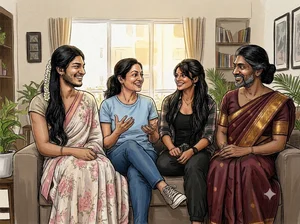
Who decided that clothing and adornments should be divided separately between men and women? Who made the rules that certain clothes should be worn only by men and others only by women?
Society praises a woman wearing a saree as beautiful, graceful, like Goddess Lakshmi, and worthy of respect. The same society also appreciates her when she wears modern outfits such as jeans and T-shirts, describing her as a modern girl, independent, and strong-minded. But why does society's perspective change when a man wears a saree, keeps long hair, and adorns himself?
When a woman wears not only sarees, churidars, and gowns but also jeans and T-shirts, society still accepts and recognizes her as a woman. However, when a man wears clothes such as sarees or churidars, why is he suddenly considered less masculine? Why do people assume that something must be wrong with him or that he must be experiencing some kind of hormonal changes? Why should he be ridiculed?
What is both ironic and disappointing is that many of the people who hold such views are women themselves. And surprisingly, some of them are modern women who wear jeans and T-shirts!
Has anyone made an agreement that jewellery, hairstyles, hair, clothing, and all forms of adornment belong exclusively to women? Or would something terrible happen if men chose to wear them as well? Or are these forms of adornment somehow unwilling to accept men?
One opinion I have frequently heard from some women is this: "Dressing like men and behaving like men is so cool and powerful!" Some have even proudly expressed this opinion in front of me. But why is it that when a man wears a saree, styles his long hair, adorns himself, or takes an interest in his appearance, he is mocked and looked down upon?
Didn't men in our own epics and mythological stories adorn themselves with jewellery, hairstyles, long hair, and different kinds of clothing?
As an example from our epic literature, we can take Arjuna from the Mahabharata. During the period of his incognito exile, Arjuna assumed the identity of 'Brihannala', living in a feminine appearance with long hair and traditional feminine adornments. Similarly, we can see male deities in our epics and Puranas adorned with jewellery, flowers, and beautifully decorated clothing. If so, why do we maintain so many gender-based distinctions when it comes to adornment?
When men accept women wearing T-shirts and jeans, why do some women refuse to accept men wearing sarees and churidars?
Some women consider the courage and confidence they gain from wearing T-shirts and jeans to be something significant. They even associate such clothing with being independent and empowered. If so, why do they refuse to accept men wearing sarees or choosing to adorn themselves?
Are courage, confidence, and independence found in clothing, or do they come from within a person's mind? If that is the case, then who is actually lacking strength here: men or women? Who is being looked down upon? Men or women?
When a woman herself does not take pride in being a woman, how is it fair for her to criticize others? I am not speaking about all women. First and foremost, a woman should take pride in being a woman.
Whether male or female, we must first understand that all living beings in this world are creations of nature. Every living being has its own role, purpose, functions, and responsibilities.
However, unlike other living beings, human beings seem to spend their entire lives caught up in a constant competition of "Who is better, you or me?"
What I am saying applies equally to everyone, regardless of whether they are men or women.
**Thank you!**
Discussion (0)