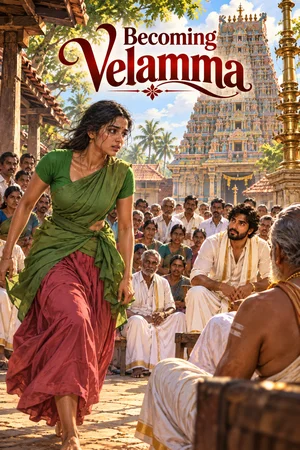
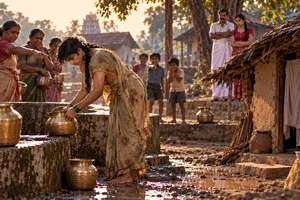
First morning as Velamma – A new life begins, shaped by cruelty, endured in silence The sky was gray with ash-like clouds when Velamma walked out of her newly assigned hut on the edge of the village, beside the garbage pit and wild weeds. It was barely large enough to lie down. No cot. No door. Just a cloth curtain and a cracked mud pot. She carried an empty brass pot in both hands. Today, like every day to come, she would walk to the outcast well. The one no one else used. The one used by stray animals, broken elders, and widows in their last years. A boy ran past her laughing and pointed: “Look! The rendungkettan is going to the thotti kulam!” The water smelled of old roots and copper. Still, she drank. Then lifted the pot, her wrists jingling with cheap green bangles the Panchayat had forced on her. At the village square, she stood on her knees, palms together in front of Mariamma Aachi, the ration keeper. “Aachi… Velamma is here for rice and dal.” Mariamma didn’t look at her. “Say it right.” Velamma lowered her head, soft voice trembling only slightly. “I, Velamma, the servant and example of this village, humbly ask for your mercy and grain, respected elder.” Only then did a small handful of rice and two spoons of dal fall into her old cloth bag. “No oil today,” Mariamma said. “Learn to cook with smoke.” No one in the village was to feed Velamma. That was law. She was allowed to cook once a day, with wood she had to gather herself. If the wood was wet, she ate raw rice. If she was late, she went hungry. This wasn’t just punishment—it was remaking. A wooden board was nailed to her hut: “VELAMMA – Village Maid. To be Obeyed by None, To Serve All.” And every person she met—even a newborn baby—had to be greeted with a bow and the words: “My respects to you. I am your humble example.” She said this to a drunken farmer, to a seven-year-old boy, to a pregnant girl younger than her, even to stray dogs when ordered by giggling children. And every time she said it, she meant it. Not out of shame. But because she had accepted the truth: “I failed. Even if it was one breath of hesitation, I failed. And for this village… that’s enough.” From the distance, Kuyili watched her brother—now a maid—gather dried cow dung for cooking fuel. Her father stood beside her, arms crossed. “She does it without complaint.” “He always did,” Thevar muttered. Kuyili whispered, not fully sure why: “I thought… if he lived this, he’d break. But he hasn’t.” Thevar turned to her, face hard. “You thought wrong.” Kuyili lowered her eyes. But somewhere inside her—deep, where the truth trembles—guilt began to breathe. Velamma sat beside a smoky fire. Her rice half-cooked, her fingers blistered. She looked up at the stars—not to pray. Just to be. She whispered: “I will carry this. So no one else has to. Let my hunger be their memory. Let my silence be their fear. Let my name fade, but let my lesson stay.” She pressed her palms together. Not to the gods. To the village.
CD Stories is a multilingual open platform. Stories published are generated by writers. The platform has not reviewed, modified, or validated contents and holds no liability regarding content quality or copyright infringements.
Discussion (0)
No comments shared yet. Be the first to share your thoughts!

Discussion (0)