
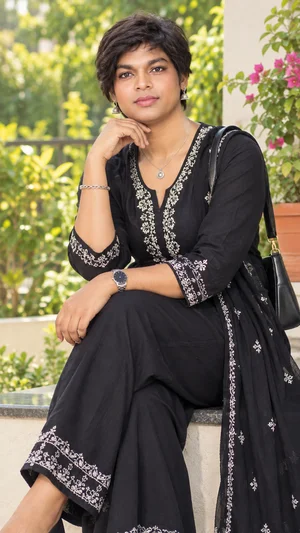
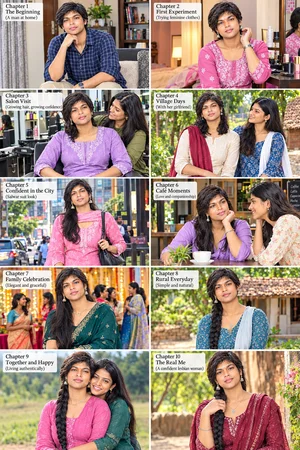
FROM DISGUISE TO SELF — ANANYA'S JOURNEY
Chapter 1 — The Beginning
For years, Arjun had lived according to a version of himself that seemed to have been written by everyone else. He wore the clothes expected of him, kept his hair short, and learned to answer questions about his future with a practiced smile. Yet, whenever he was alone, he felt that something essential was missing.
The change began quietly. Arjun started keeping a private notebook in which he wrote about the person he imagined becoming. In those pages, he did not describe himself as a completely different person. He described the same memories, the same sense of humor, the same love of music and village walks—but with a feminine name and a freedom to dress in ways that felt natural.
His closest friend, Meera, was the first person he trusted enough to tell. She listened without trying to define him. Over many conversations, Arjun realized that his feelings about gender and his feelings about romance were separate questions. He wanted to live as a woman, and he was also attracted to women.
The realization frightened him at first. He had grown up hearing people use the word “lesbian” as though it belonged to someone else's world. Eventually, however, he understood that the word could describe him too: a woman who loved women.
The decision to transition was not made overnight. Arjun sought professional support, talked with people who had gone through similar journeys, and carefully considered what he wanted. After gender-affirming treatment and surgery, she chose the name Ananya.
The first morning she looked at herself and said the name aloud, it felt strangely ordinary—and deeply right.
She was still the same person who loved spicy food, old songs, and long conversations. But for the first time, the outside world was beginning to match the person she had carried inside for years.
Chapter 2 — First Experiment
Ananya's first experiments with feminine clothing were much less dramatic than she had imagined. She started with a simple pink kurta borrowed from Meera. It felt unfamiliar at first, so she stood in front of the mirror for several minutes, adjusting the sleeves and wondering whether she looked convincing.
Meera smiled. “You don't have to convince anyone,” she said. “Just ask whether you feel comfortable.”
That question changed the entire experience.
Ananya tried a few combinations: a cotton kurta with leggings, a long scarf, small earrings, and finally a pair of sandals. She laughed when she realized she had spent almost an hour deciding which earrings to wear.
Cross-dressing had once felt like a secret performance. Now clothing became something different—a language through which Ananya could explore herself.
She also began growing her hair. The first few months were awkward. Her hair reached her ears, then her neck, and eventually her shoulders. She learned how to condition it, how to keep it from becoming tangled, and how to tie it back when she was cooking.
There were still days when she questioned everything. On those days, Meera never pushed her. They would simply sit together, drink tea, and talk.
One evening, Ananya tried a bright embroidered kurta and stood near the bedroom window. The sunset lit the room orange. She caught her reflection in the glass and smiled.
“I think I'm starting to see her,” she whispered.
“She's been there all along,” Meera replied.
That sentence stayed with Ananya.
The clothes did not magically create a woman. They simply gave her another way to express the woman she already understood herself to be.
Chapter 3 — Salon Visit
By the time Ananya's hair reached her shoulders, she had become protective of it. What had begun as an experiment had become a meaningful part of her transition. She wanted it to grow much longer, eventually reaching the middle of her back.
Meera took her to a salon where the stylist helped shape the growing hair without cutting away too much length. Ananya chose soft layers around the face and asked for advice on keeping the ends healthy.
When the stylist finished, Ananya turned toward the mirror.
The woman looking back at her had the same eyes she remembered from childhood, but everything about the presentation felt more harmonious. Her hair framed her face, the simple lavender kurta suited her, and a pair of silver earrings caught the light.
She did not look like someone pretending to be a woman.
She looked like Ananya.
The salon became a place of confidence rather than disguise. Over the following months, she learned small things that made daily life easier: how to braid her hair, how to choose clothes according to the weather, how to match earrings with a kurta, and how to carry herself comfortably.
Most importantly, she stopped treating femininity as a costume.
Her relationship with Meera also changed. Their friendship had slowly become love. They began holding hands in quiet places, sharing meals, and talking about the future.
One evening, Ananya admitted that she was nervous about calling herself a lesbian.
Meera squeezed her hand. “You don't have to prove the word to anyone. If woman is who you are and women are who you love, then that is your story.”
Ananya smiled.
For the first time, she was not merely changing her appearance. She was building a life that made sense to her.
Chapter 4 — Village Days
Ananya and Meera eventually travelled to a village where they could spend a few quiet days away from the city. Ananya packed several cotton outfits, including a cream kurta with a red dupatta.
The village was full of familiar sounds: bicycles passing on dusty lanes, birds calling from trees, women chatting near courtyards, and the distant rhythm of farm work.
Ananya loved it immediately.
She wore her hair loose on the first morning, but the afternoon heat convinced her to make a simple braid. Meera watched as Ananya practiced until the braid was neat enough.
“You're getting good at that,” Meera teased.
“I'm getting good at being me,” Ananya answered.
They walked together through the village, sometimes stopping to buy fruit or speak with shopkeepers. Ananya noticed that the more naturally she behaved, the less she thought about whether people were examining her.
That evening, they sat outside a traditional house while the sky turned gold.
Meera asked what Ananya wanted her future to look like.
“A home,” Ananya said. “Work I enjoy. Long hair. Comfortable clothes. And someone beside me who knows all the difficult parts of my story.”
Meera smiled. “Sounds familiar.”
They laughed.
The village trip taught Ananya something important. Confidence did not mean never feeling nervous. It meant continuing to live honestly even when nervousness appeared.
She also began imagining herself with much longer hair. She pictured a thick braid falling to the middle of her back, decorated occasionally with flowers.
It was a small dream, but it represented something larger: patience.
Her transition had not been a single event. It was a collection of ordinary days in which she became increasingly comfortable with herself.
Chapter 5 — Confident in the City
Returning to the city gave Ananya a chance to test the confidence she had developed in the village.
She chose a pink salwar suit, carried a black handbag, and left her hair open. The hair had grown well past her shoulders and was beginning to reach her upper back.
At first she felt every pair of eyes around her.
Then she noticed that most people were simply busy with their own lives.
She entered a bookstore, bought a novel, stopped for coffee, and later walked through a busy shopping street with Meera. The day felt surprisingly ordinary.
That ordinariness was precious.
Ananya had once imagined that becoming herself would require a dramatic moment when everyone around her suddenly understood. Instead, her freedom came through small experiences: buying clothes in her own style, visiting a salon without embarrassment, choosing jewelry because she liked it, and walking beside the woman she loved.
At the café, Meera asked whether Ananya regretted anything.
“I regret waiting so long to listen to myself,” Ananya said.
“But you listened eventually.”
Ananya smiled.
She was also learning that cross-dressing and gender expression could mean different things to different people. For her, wearing feminine clothing was not simply about pretending to be someone else. It was part of a larger personal transformation and a way of presenting herself as the woman she knew herself to be.
Before going home, she bought a new hairbrush and a simple set of silver bangles.
That evening, she stood before the mirror and practiced a braid.
It reached farther down her back than it had ever done before.
She laughed with delight.
Chapter 6 — Café Moments
The relationship between Ananya and Meera became more openly affectionate with time. They still preferred quiet places, but they no longer felt the need to hide every expression of closeness.
One Saturday afternoon, they met at a small café.
Ananya wore a lavender kurta and delicate earrings. Her hair was long enough to fall over one shoulder, and she had tied a portion of it back with a simple clip.
Meera arrived carrying two books.
They spent hours talking about ordinary things: movies, food, work, family, and a possible trip to the countryside.
Eventually, the conversation turned serious.
Ananya admitted that sometimes she worried people would see her entire life only through the lens of her transition.
Meera answered carefully. “Your transition is part of your story, not the whole story.”
Ananya thought about that.
She was a woman who had undergone a difficult transformation. She was also a daughter, a friend, a reader, a traveler, a person who loved music—and a lesbian who had fallen in love with another woman.
Those identities did not cancel one another.
Later, as they walked home, Meera reached for Ananya's hand.
Ananya squeezed it.
The gesture was simple, but it carried years of fear and hope.
At home, Ananya began taking better care of her hair. She used gentle products, protected it while sleeping, and stopped cutting it except for occasional trims. Her goal was clear: mid-back length.
She wanted to look back one day and see not a costume, but a continuous journey from the uncertain person she had once been to the confident woman she was becoming.
Chapter 7 — Family Celebration
A family celebration became the biggest test of Ananya's confidence.
She chose a deep green sari with a modest embroidered border. Her hair had become long enough to form a substantial braid, and she wore a small necklace and matching earrings.
Before leaving, she stood silently before the mirror.
For years, family gatherings had been places where she worried about questions and judgments. Now she decided she would attend as herself.
The evening was full of lights, music, food, and conversation. Some relatives were curious. Others were cautious. A few simply treated Ananya as they would any other family member.
The most meaningful moment came when an older relative complimented her hair.
“You've grown it so beautifully,” she said.
Ananya smiled.
It was such a small sentence, but it made her eyes fill with tears.
Later, she introduced Meera to several relatives as the woman she loved. The introduction was simple, without a dramatic announcement.
“This is Meera.”
Meera smiled and greeted everyone.
Ananya realized that acceptance did not always arrive in one grand moment. Sometimes it appeared gradually—in a shared meal, a compliment, a conversation, or a relative choosing to stay beside you.
On the way home, Meera told her she had looked beautiful.
Ananya answered, “I felt beautiful.”
That distinction mattered.
She was no longer dressing to convince the world. She was dressing because the clothes belonged to the life she had chosen.
Chapter 8 — Rural Everyday
After the family celebration, Ananya spent several weeks in the countryside.
Here, she preferred practical clothes: a blue cotton kurta, comfortable trousers, a light dupatta, and simple sandals. Her long hair was usually gathered into a braid so she could work comfortably.
She helped prepare vegetables, walked along the fields, and visited a nearby market with Meera.
There was something peaceful about being dressed simply.
Ananya had once believed that femininity required elaborate clothing. Now she understood that a woman could feel feminine in a cotton outfit, with no makeup and a practical braid.
Her hair had reached the middle of her back.
One morning, she stood beneath a tree while Meera carefully finished the braid.
“It's finally as long as you wanted,” Meera said.
Ananya touched the end of it.
“Yes,” she replied. “But I think the best part is that I didn't rush it.”
The same was true of her entire transformation.
She had wanted a dramatic before-and-after moment, but real life had given her something better: hundreds of small changes that accumulated over time.
That evening, they watched the sunset from a hill outside the village.
Ananya rested her head against Meera's shoulder.
She felt no need to explain herself.
For the first time, she was simply living.
Chapter 9 — Together and Happy
By the ninth chapter of their journey, Ananya and Meera had built a rhythm that felt natural.
They cooked together, disagreed about movies, went shopping, visited relatives, and planned holidays. Their relationship was not defined by Ananya's transition. It was defined by companionship.
Ananya's wardrobe reflected that confidence.
Some days she wore jeans and a long top. Other days she chose a salwar suit. For celebrations, she wore a sari. At home, she preferred simple cotton clothes.
Her mid-back-length hair had become one of her favorite features. Sometimes she left it loose. Sometimes she tied a ponytail. Her favorite style was still the thick braid she had dreamed about during the earliest days of her transition.
One afternoon, she and Meera took photographs outdoors.
Ananya looked at one photograph and laughed.
“I barely recognize the person I was years ago.”
Meera shook her head. “I do. She's still in there.”
Ananya considered this.
Meera was right. Transition had not erased her past. It had allowed her to understand it differently.
The person she had once called Arjun had struggled, questioned, and searched for answers. Ananya did not hate that person. She felt grateful for the courage it had taken to begin the journey.
She also knew that her lesbian identity was not something she had acquired because of clothing. Her romantic orientation was part of her own understanding of herself as a woman.
That distinction made her story feel complete.
She was not playing a role.
She was living her life.
Chapter 10 — The Real Me
Years after the first hesitant experiments with clothing, Ananya stood in front of a mirror with her hair falling to the middle of her back.
She wore a simple maroon traditional outfit, silver earrings, a small necklace, and a bracelet. Her hair was gathered into a long braid that rested over one shoulder.
She smiled.
There had been no single day when she suddenly became the person she wanted to be. Instead, there had been thousands of choices: seeking support, beginning transition, undergoing gender-affirming surgery, learning to dress comfortably, growing her hair, facing family conversations, falling in love, and allowing herself to live openly.
Her relationship with Meera had grown alongside her.
They had learned that love was not about rescuing one another. It was about listening, respecting boundaries, sharing responsibilities, and making room for each other's growth.
That evening, they walked through a garden together.
Ananya held the end of her braid in one hand as they talked.
She remembered the first time she had tried a borrowed pink kurta. She remembered the nervous salon visit. She remembered the village trip, the café conversations, the family celebration, and the moment her hair finally reached the middle of her back.
Every memory felt like a page in the same book.
Meera looked at her and smiled.
“What are you thinking?”
Ananya touched her braid and answered, “That I finally stopped trying to become somebody else.”
They continued walking.
Ananya was a woman. She was a lesbian. She was a partner, friend, and family member. She was also simply Ananya—a person whose life could contain far more than the story of her transition.
The braid swung gently as she walked.
For the first time, she did not see it as proof of transformation.
She saw it as a symbol of patience, self-knowledge, and the long road toward becoming comfortable in her own life
Discussion (0)