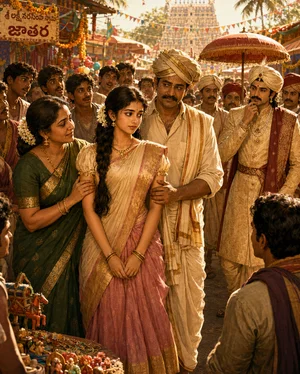

The father stared at him in astonishment.
“My lord?”
“From now on, your daughter shall remain Jamuna forever. My desire for her is the strange event that was destined to happen today. I shall give you a thousand acres of land. I shall grant you an entire village. But I will accept Jamuna only as a woman.”
The father’s eyes widened.
There was a blessing in those words, but there was bondage too. There was generosity, but there was also the taking away of another person’s right to choose.
In those days, it was not easy for ordinary people to oppose the word of a zamindar. The father faltered. From a distance, the mother watched in fear. Jamuna had not heard the entire conversation, yet her heart had already sensed that the course of her life was changing there and then.
The zamindar summoned the members of his household. His two wives arrived at the festival and stood before them. There was stern silence on the face of the elder wife and astonishment on that of the younger. Village elders, priests, and servants gathered around.
A small wedding pavilion was prepared in the middle of the festival itself.
Weeping, Jamuna’s mother straightened her braid. Her father’s hands trembled. Jamuna’s eyes grew wet—perhaps with fear, perhaps with confusion, or perhaps with the profound silence of someone leaving behind one self and stepping into another life.
The zamindar tied the sacred marriage thread around her neck.
At that moment, the drums sounded. The crowd cried, “May it be auspicious!”
The clamour of the festival covered the decision in the appearance of celebration.
But in Jamuna’s heart, one question remained:
“By whose decision am I becoming what—and for whom?”
That age had no answer to her question.
Jamuna entered the zamindar’s mansion.
There she was given royal chambers, silk saris, jewels, maids, servants, and elaborate customs. She received everything. But there was no place for her former name, her former body, or her former confusion.
The zamindar consulted physicians from across the country and from foreign lands. He summoned practitioners of the medical knowledge available in that age—Ayurvedic healers, Unani physicians, and doctors trained abroad. He was determined that Jamuna’s body should move towards what he considered complete womanhood.
How scientific or dependable those treatments were, history does not tell us. Folktales merely say that Jamuna gradually settled into a female form. They say that her walk, her voice, her habits, and the softness of her body became increasingly feminine.
But she could not bear children.
At first, this fact stood like an unspoken word within the zamindar’s household. Her co-wives could have used it as a weapon against her. But perhaps because of Jamuna’s good fortune, or perhaps because of her nature, that never happened.
One day, the elder wife said to her:
“When you first arrived, I could not understand whether you were the beginning of our good fortune or the beginning of our fear. But now I see that you did not bring conflict into this house. You brought gentleness.”
The younger wife smiled and said:
“When I see the way you care for our children, I understand what it means to be a mother without having given birth.”
Jamuna’s eyes filled with tears.
She bore no children of her own, but all the children of her co-wives grew up in her lap. Whenever one of them had a fever, Jamuna stayed awake through the night. Whenever a child struggled with a lesson, Jamuna taught it patiently. During festivals, she made sure that every child had new clothes. When her co-wives were tired, she combed their hair.
She carried sorrow over the womb that had never been hers. Yet she gave completely of the motherhood that life had placed within her reach.
The zamindar grew old. Jamuna too advanced in age. But a strange serenity deepened within her.
The man who had first accepted her for her beauty eventually came to honour her as the peace of his household.
One day, he asked her:
“Jamuna, do you remember the day I saw you at the festival?”
Jamuna smiled gently.
“Even if I forget it, my lord, that village never will.”
“At the time, I was proud to think that I had transformed you into a woman,” he said slowly. “But now I see that it was this entire household that became gentler in your hands.”
Jamuna remained silent for a while. Then she said:
“My lord, no one transformed me completely. No one ever understood me completely either. Everyone saw in me the form they wished to see.
“The astrologers saw a curse. My parents saw fear. You saw beauty. But the children of this house saw only my lap. That is why I found peace with them.”
Hearing her words, the zamindar lowered his head.
For many years afterwards, the story of Jamuna continued to be told in Pallalamma village.
Some called it a story of destiny.
Some called it the zamindar’s love story.
Some called it a strange and wondrous tale.
But the grandmothers would say softly:
“Everyone at the festival saw Jamuna. But God alone knows who ever saw Jamuna’s heart.”
There is a blessing in this story.
There is coercion hidden within generosity.
There is possession hidden within admiration of beauty.
There is a female form born out of fear.
And in the end, there is a life that found its own place through motherhood.
Jamuna never gave birth to children.
Yet she spread her fragrance through their lives.
She stood beside her husband as a woman.
She became not an enemy to her co-wives, but a sister.
Jamuna, who had appeared at the festival like a streak of lightning, finally became the lamp of a household.
That is the story of Jamuna at the village festival.
Discussion (0)