The Secret (Grand Mother Stories)
Part One — The Garland Bond
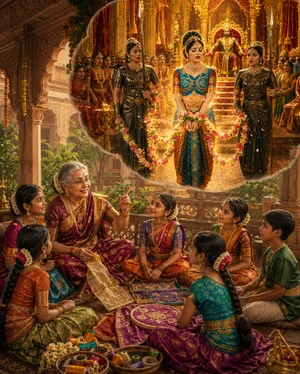
“Come here, children,” Grandmother called.
There was more affection than command in her voice. One by one, we left the place where we had been playing and gathered around her.
“I will teach you how to embroider designs on cloth. Watch and learn, and listen to the story I tell you,” she said.
Grandmother loved seeing us dressed in traditional clothes. In particular, once we had crossed the age of ten, she insisted that we wear silk skirts and blouses.
“Clothing, too, should express the refinement appropriate to one’s age,” she often said.
And so, along with my two elder sisters, I wore a silk skirt and blouse. The three of us had not yet begun wearing half-saris. A few children from the neighbouring houses also came and sat in a circle around Grandmother. In front of each child lay small pieces of cloth, coloured threads, and needles.
Grandmother spread a piece of white cloth across her knees. With red thread, she began embroidering a small flower upon it.
“Do you know what embroidery is?” she asked.
We all looked at one another.
“The thread enters the cloth and comes out again. For a while, it is visible. Then it disappears. But in the end, when you look at it, it has become a flower. A story is like that too. Some truths are not visible at first. They remain hidden. Only when their time comes do they emerge like flowers.”
A gleam appeared in Grandmother’s eyes.
“The story I am going to tell you today is such a story. Its name is—The Secret.”
She pushed the needle through the cloth once more.
“It happened in the kingdom of Panchanada, ruled by King Vikramasena…”
****************************************
That day, the royal court of Panchanada shone with unusual splendour.
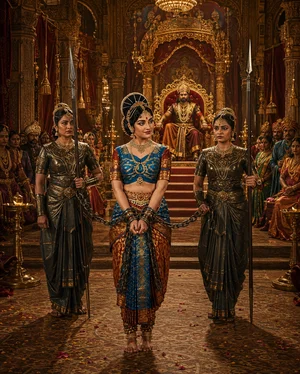
Golden arches gleamed behind the throne. The light of the lamps flowed across jewel-studded pillars and cast a delicate embroidery of light and shadow upon the floor. Behind curtains of pearl, the faint movements of the women of the inner palace could be seen. The centre of the court had been deliberately left empty—as though some judgement were about to be born there.
Upon the throne sat Vikramasena, sovereign of Panchanada. Royal dignity shone upon his face, but vigilance remained in his eyes. A king must search not only for meaning in every word he hears, but also for danger. Vikramasena was such a king.
To his right sat the minister. To his left stood the commander of the army, Prachanda. True to his name, there was great fierceness in his nature. Armour gleamed upon his shoulders, yet the hardness in his eyes shone more brightly than the metal.
The courtiers sat on either side—royal priests, feudal lords, military officers, aged ministers, and young administrators. Every gaze was turned towards the entrance of the hall.
The doorkeeper’s voice rang out solemnly.
“The prisoner Sulochana is being brought into the royal court!”
At once, the murmurs in the hall ceased.
Two female guards entered first. Long spears rested in their hands, and swords hung at their waists. Discipline marked their steps. Severity marked their faces.
Between them walked Sulochana.
Iron shackles bound her hands. Cold, dark metal encircled her wrists. The two ends of the chain were held by the female guards. To anyone else, those chains would have signified captivity. Yet the instant the court beheld her, the chains themselves seemed strangely small. At first glance, the assembly appeared to understand that they were not enough to bind her.
Sulochana stood in the centre of the court.
For a single moment, the entire hall forgot to breathe.
From head to foot, she seemed an ocean of rare beauty. Her tender feet, delicate as lotuses, rested upon the floor as though the earth itself bore them gently. There was no dance in her step, yet rhythm lived in her walk. There was no arrogance in the way she stood, yet there was an unyielding cadence in her bearing.
The graceful lines of her form seemed as though they had first taken shape in a sculptor’s dream and only later entered the human body. Her thighs, rounded and elegant like those of the celestial dancer Rambha, bore witness not merely to feminine beauty but also to perfect balance. Her waist was slender like the middle of a warrior’s bow, yet there was no weakness in that slenderness. The curves of her body possessed an almost measured and classical precision.
At the centre of that scarcely visible waist, her navel seemed like a cosmic spiral turning within the sky. Seen from the side, the curve of her breasts resembled the arc of a bow—not a line that merely arrested the gaze, but a silent proclamation through which womanhood declared itself.
Above it rose a neck like a conch, and a face like the full moon. Modesty dwelt upon that face, but not fear. Gentleness was there, but not the submission of a slave.
Her long black hair flowed down her back, dark enough to rival a row of bumblebee wings. Her hands were bound—but not her beauty. Not her gaze. Not the invisible circle of dignity that stood around her.
The members of the court were spellbound. Yet it was not beauty alone that held them. Before them, womanhood stood like a secret scripture, dance like a silent Veda, and beauty like an enchanted power.
Even Vikramasena remained motionless for a moment. Then he mastered himself and turned towards his minister.
Understanding the king’s glance, the minister questioned Commander Prachanda.
“What is the charge against this woman?”
Prachanda stepped forward. There was a hardness in his voice that concealed a sense of triumph.
“Your Majesty, she is a young woman from an enemy kingdom. Her name is Sulochana. For several months, she has been teaching dance to Princess Kumudvati within the inner palace.”
The minister’s brows drew together.
“And?”
“Yesterday, a pigeon came to her. A small piece of silk had been concealed between its wings. Written upon that silk was the question: ‘Is everything favourable to us?’”
A wave of whispers passed through the court.
Prachanda continued.
“Her reply was: ‘Everything is favourable.’ It was through that pigeon that this woman fell into our hands.”
Vikramasena’s face hardened.
“Sulochana,” he said, “is this true?”
Sulochana gently bowed her head.
“My respects, Your Majesty. The pigeon is real. The silk cloth is real. The question is real. My answer is also real.”
This time, the murmurs in the court deepened into open suspicion.
A faint smile appeared at the corners of Prachanda’s lips.
But Sulochana had not finished.
“However,” she said, “truth does not exist in a single fragment, Your Majesty. Like letters written upon folded silk, it too can remain concealed. Only when it is unfolded does its full meaning become clear.”
The minister leaned forward.
“Then unfold it. Speak.” (To Be Continued)
Discussion (0)