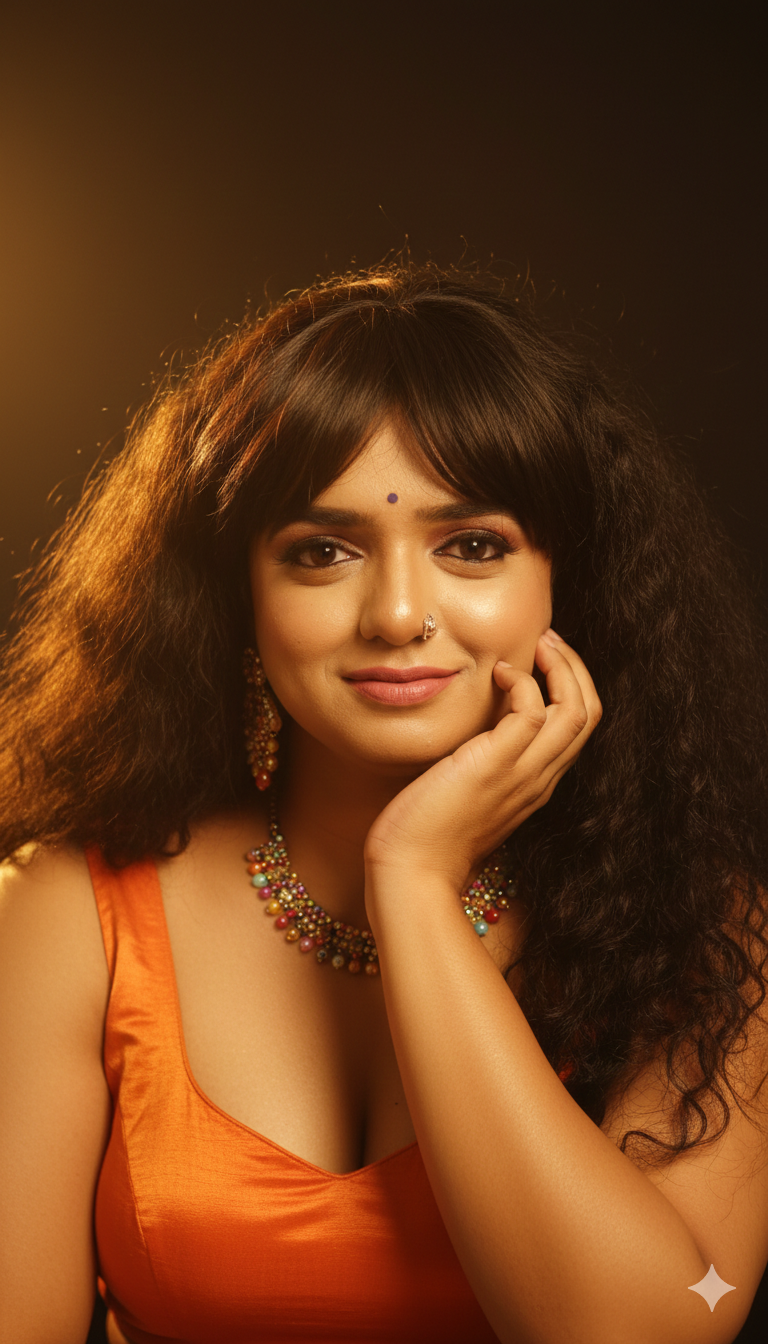
Chapter 3: The Architecture of Illusion
The mist of the Western Ghats was still a cold ghost on Arnav’s skin as he climbed the sagging stairs of the tenement in the Old City. The building was a relic of a forgotten era, held together by lime-wash, tangled electrical wires, and the persistent scent of jasmine and decay. He carried the indigo bundle from the yogi like a piece of stolen evidence.
At the end of the third-floor corridor, a door of heavy, darkened teak stood slightly ajar. Arnav pushed it open. The room inside was a sensory paradox. It smelled of ancient Unani herbs—bitter, earthy, and sharp—mixed with the synthetic, cloying scent of spirit gum and silicone.
Ruksana was waiting. She was a woman who seemed to exist in the shadows of the spotlight, a retired theatre artist whose hands had shaped a thousand illusions. She didn't look at Arnav’s face; she looked at his silhouette.
"You’re late," she said, her voice like a dry leaf skittering over stone. "The moon doesn't wait for billionaires."
"The mist was thick," Arnav replied, his voice still carrying the crisp authority of a man who owned the horizon.
"Strip," Ruksana commanded, pointing to a low wooden stool placed before a cracked, triptych mirror. "Arnav Reddy dies in this room. If a single trace of him walks out that door, your mother’s life is the price. Don't look at me with those 'Steel CEO' eyes. Here, you are a block of clay."
Arnav hesitated, his fingers trembling as he reached for his silk tie. He removed the charcoal-grey suit, the bespoke shirt, and the heavy watch, standing in the centre of the room. He felt stripped of more than just fabric; he felt stripped of his Armor.
Ruksana walked around him, clicking her tongue. She stopped behind him and reached for his hair. Arnav had spent the last year growing it—not by choice, but because Savitri had made him take a religious vow for a Mokku at Tirupati. She had insisted he shouldn't touch a blade to his head until they walked the thousand steps together. It was a long, dark mane, currently pulled back into a severe, masculine knot.
"Your mother’s piety is your greatest disguise," Ruksana murmured. She pulled the band away, and the hair fell in a heavy wave down his back. "Most men would have to wear a wig. A wig is a lie that can slip. Real hair... real hair is a truth that binds."
She picked up a heavy wooden comb and began to brush. The sensation was alien to Arnav. The tugging, the rhythmic stroking—it felt like she was combing away his very thoughts.
"It’s too long," Arnav muttered, his jaw tight. "It feels... heavy."
"It’s the weight of your promise," Ruksana snapped.
She began to section the hair with a precision that was almost surgical. Arnav watched in the mirror as her fingers flew, weaving the dark strands into a thick, traditional three-ply braid. She pulled the hair tight at the nape, a sensation that forced Arnav to tilt his head back, exposing the vulnerability of his throat. He felt a sharp prick of discomfort as she wove a black silk thread into the end of the braid, finishing it with a heavy, brass-tipped tassel.
"The braid is a spine," Ruksana said. "It will remind you to keep your head down. If you toss your head like a man, the weight of this braid will pull you back. It is your first lesson in the 'Smallness'."
Next came the physical reconstruction. Ruksana reached into a clinical-looking case and pulled out two teardrop-shaped forms made of medical-grade silicone. They were soft, heavy, and held a terrifyingly human warmth.
"Silicone breast forms," she explained, ignoring Arnav’s visible wince. "They are weighted to match the density of a woman your height. If you are too flat, you are a boy. If you are too large, you are a target. These are the middle path."
She applied a thick, clear adhesive to the back of the forms. "This is a specialized skin-bond. It is used in heavy prosthetics. It will not move, not even in the 40-degree heat of the factory floor. But it will itch. It will feel like your skin is breathing through plastic. That is the price of the illusion."
Arnav stood as still as a statue as she pressed the forms onto his chest. The adhesive was cold, then suddenly hot as it bonded with his skin. The weight was immediate—a subtle shift in his center of gravity that made his chest feel heavy and constricted.
"It... it feels like I'm suffocating," Arnav gasped, his hands hovering over the new contours of his torso.
"You’re not suffocating. You’re just feeling the space you used to ignore," Ruksana said.
She moved to his hips, strapping on two contoured pads made of a dense, breathable foam. They sat over his iliac crests, widening the lean, athletic line of his waist. "Men move in straight lines. Women move in circles. These pads will force your saree to drape with a curve. They will change the way you walk. You cannot stomp like a king when your hips have a different geometry."
Arnav looked at himself. The silhouette in the mirror was no longer his. The broad shoulders were still there, but they were countered by the new weight on his chest and the softness at his waist. He felt like a stranger in a house that was being remodeled while he was still inside it.
"Now, the voice," Ruksana said. She picked up a small, opaque blue bottle from a shelf filled with Unani tinctures. The label was handwritten in Urdu script. "This is a Sherbet-e-Niswa. It is an old recipe, inspired by the Unani doctors who served the harems of the Nizams. It contains extracts of blue lily, crushed pearls, and a herb from the valley of the mist."
She poured a thick, viscous green liquid into a silver cup. "Drink. All of it."
Arnav took the cup. The smell was overwhelming—like wet earth and crushed violets. He drank. It was bitter, with a metallic aftertaste that made his tongue go numb. As the liquid slid down his throat, he felt a cooling sensation, as if his vocal cords were being coated in silk.
"Speak," Ruksana commanded.
"What do I say?" Arnav asked.
He jumped at the sound of his own voice. The resonant, chesty baritone was gone. In its place was a low, gravelly rasp—a voice that sounded like a reed vibrating in the wind. It wasn't high-pitched; it was simply soft, stripped of its edge, its authority dissolved.
"The drink numbs the thickening of the vocal folds," Ruksana explained. "It will last for seven days. You will drink it every Sunday. If you try to roar, you will only hiss. It is a leash for your tongue."
Arnav tried to clear his throat, but the numbness remained. He felt a sudden wave of nausea, a visceral rejection of the chemicals, the silicone, and the pins. "I don't know if I can do this, Ruksana. It’s... it’s too much."
"The yogi said you had to find a heart," Ruksana said, her voice softening for the first time. "A heart is a heavy thing. Now, sit. We begin the upkeep."
For the next two hours, Arnav was a student of the mundane. Ruksana sat him down and forced him to watch as she applied kohl to his waterlines. The wooden stick felt like a needle, the black soot stinging his eyes until they watered.
"Don't blink," she hissed. "A woman’s eyes are her only weapons in the factory. They must be deep. They must be tired."
She taught him the "Upkeep of the Skin." She handed him a rough pumice stone and a jar of thick, sandalwood-scented cream. "Every night, you will scrub your hands. The indigo dye will stay, but the callouses must go. You must have the skin of a woman who has worked, but has not forgotten she is a woman."
She showed him how to apply a bindi—a small, dark maroon dot placed exactly between his reshaped eyebrows. "This is the third eye. It is the point of focus. If it is crooked, your whole face is a lie."
The final lesson was the most difficult: the movement. Ruksana made him walk across the cramped room while wearing a pair of simple, flat leather chappals.
"No! You are marching!" she shouted, hitting his calf with a cane. "Small steps. Keep your knees together. Let the braid on your back dictate the rhythm. You are Maya now. Maya doesn't lead the way; she follows the gaps."
Arnav stumbled, the weight of the silicone forms shifting against his chest, the hip pads rubbing against his thighs. The midnight-indigo handloom saree was the final layer of the cage. Ruksana draped it with a terrifying efficiency, pinning the charcoal blouse so tightly that Arnav’s breath came in shallow, feminine hitches.
"The saree is the six yards of your penance," Ruksana said, tucking the final pleat into his waist. "It is the most sophisticated disguise on earth, and the most demanding master. It will tell the world who you are, and it will tell you what you cannot do."
Arnav stood before the triptych mirror. He looked at the indigo-draped figure. He saw the long, heavy braid resting over his shoulder, the dark kohl-rimmed eyes, the soft curves of the silicone and foam. He looked at his hands—the blue dye already staining the cuticles, the silver-gray scar on the thumb hidden by the shadow of the drape.
He tried to stand straight, to assert the Arnav he knew, but the braid pulled at his scalp, the pins bit into his ribs, and the numbing sherbet in his throat made his breath feel like a whisper.
"I feel... like I've disappeared," he rasped.
"Good," Ruksana replied, handing him a tattered cloth bag. "That means the CEO is dead. Now, go. The bus for the industrial belt leaves in twenty minutes. From this moment on, if you look back, you turn to salt."
Arnav walked out of the flat and into the dawn of the Old City. Every step was a battle with the fabric, every breath a reminder of the adhesive on his skin. He was Maya, a woman of indigo and shadows, walking into the dust of his own empire.
Mother · English
The Six Yards of Penance
Completed
|
Part 4 of 17
|
1 Likes
Part 4
6015 Views
1 Comments
Disclaimer
CD Stories is a multilingual open platform. Stories published are generated by writers. The platform has not reviewed, modified, or validated contents and holds no liability regarding content quality or copyright infringements.
Reading preferences
100%
Discussion (1)
Such a beautiful read ❤️ loved everything